Category: Misc.

  • Nuraphone Headphones Review

    Nuraphone Headphones Review

    For the past few months I’ve been bombarded with adverts for some supposedly next generation headphone technology which adapts to your individual hearing, the ‘Nuraphone’. Various industry professionals were shown in the accompanying videos, reacting with apparent amazement at the sound quality. As a bit of an audio geek, I wanted to see for myself whether or not there was anything to the claims, and ended up picking up a pair recently – something that probably also partly confirms that online marketing campaigns really do work.

    One thing that’s worth noting is that Nura released a software upgrade for the headphones at the end of July which added a bunch of features, and corrected some issues that people had reported. They even added in active noise cancellation – which wasn’t present before. That is particularly cool, and something that it’s good to see a company do. Newer stock of the Nuraphone come pre-loaded with this update.

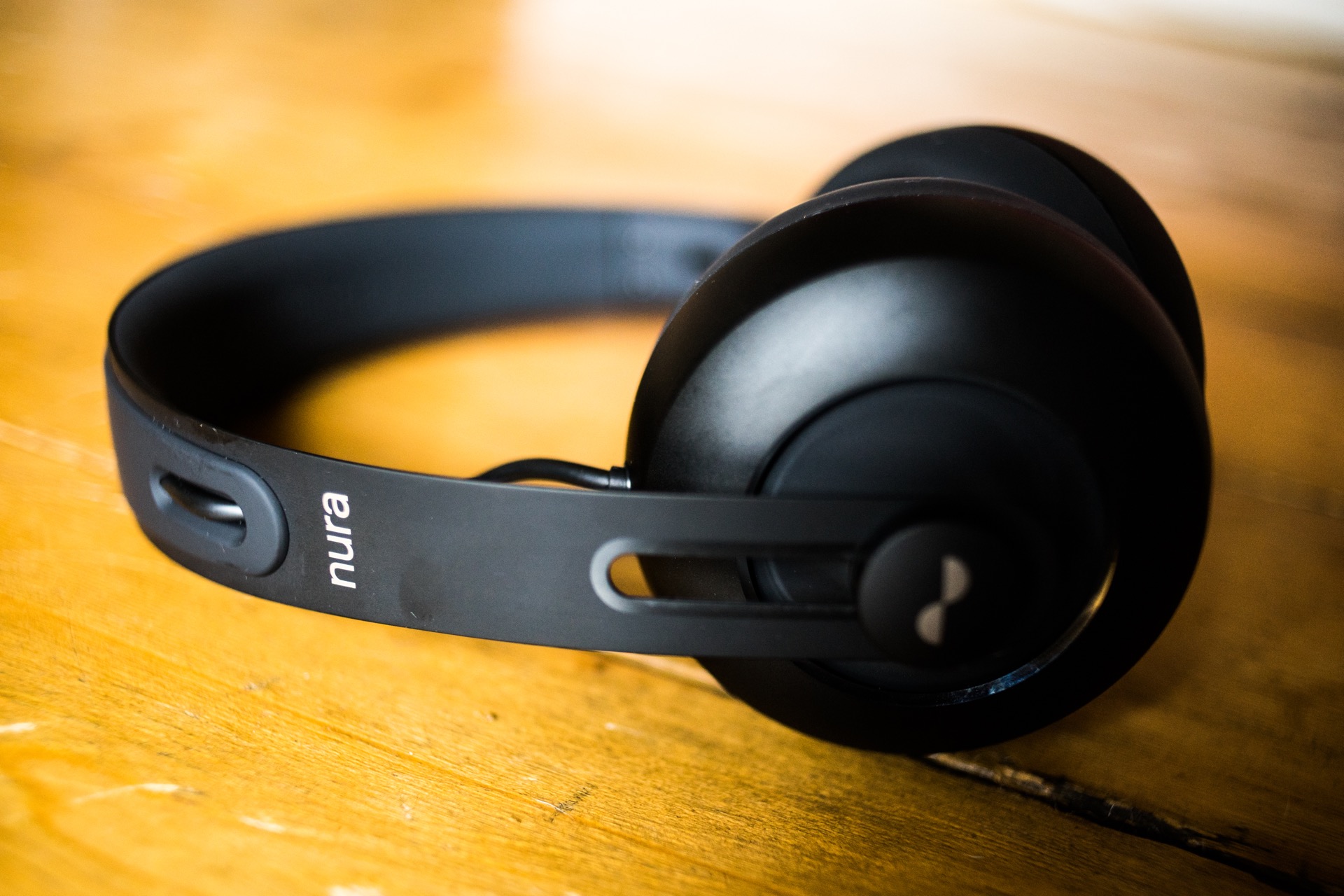
    Nuraphone

    The Concept

    Custom Hearing Profiles

    The main principle behind the Nuraphone is relatively simple, in theory at least. You first connect them to a smartphone app, where some quick tests result in a custom ‘hearing profile’ being created. This profile is then stored in the headphones, and playback is tailored accordingly – theoretically resulting in sound that is far more pleasing to your ears than a generic approach would provide.

    Over and In-Ear Design

    The other main defining characteristic of the Nuraphone is their unique over/in-ear design. The outer silicone cup encloses your ears (and doesn’t irritate any of my many cartilage piercings), and delivers bass frequencies, whereas the inner ear portion sits just inside your outer ear, delivering the mid and treble frequencies. This helps provide a nice separation, and a much fuller sound. It works very well, though does feel pretty weird at first.

    Immersion Mode

    Immersion mode uses drivers in the outer cups to provide ‘feeling of a live performance’. This basically makes the bass much fuller and deeper, without compromising on the quality of the mid or treble frequencies.Nuraphone

    What Other People Say

    I was intrigued by the Nuraphone, but also pretty skeptical. It didn’t help that the reviews online ranged wildly from the bizarrely enthusiastic to the dismissive. There were many puff pieces from sites who were clearly just happy to get a free pair, but there were also users who claimed that they and their friends had the quality was so good that they had actually been moved to tears on their first listen. Others weren’t as enamoured, angrily dismissing the Nuraphone as nothing but marketing spin, or even suggesting that £30 generic earbuds sounded just as good. Ouch.

    In general, many of the criticisms seemed to focus on the following:

    • The design was too heavy and uncomfortable – especially if you have glasses.
    • The sound wasn’t that impressive.
    • The setup was complicated and confusing, resulting in different profiles every time.
    • The ‘generic’ profile that you compare your personalised profile with sounded worse than it should, and that something shady must be going on.

    I don’t think I’ve ever seen such conflicting experiences with a single product, which only pushed me to try them out for myself.

    My Experience

    Setup

    Setting up the headphones was as simple as downloading the app, connecting via Bluetooth, and following the on-screen instructions. I had no bother getting the cups in the right place, and despite trying the calibration process a few times, my profiles were pretty much the same each time. It couldn’t really have been much easier.

    Nuraphone
    Brand new Nuraphone with the plastic wrap still intact.

    The one real annoyance is that once set up is complete, you’re encouraged to switch between a generic ‘flat’ profile and your own personalised one to hear the difference. As many people have commented online, the problem is that the generic profile sounds pretty terrible on its own – far worse than you would expect even as a baseline from far cheaper headphones. It’s as if it has been heavily compressed. As a result it all seems a bit disingenuous, and Nura have probably not done themselves many favours by including this ‘feature’.

    Comfort

    After reading all of the negative reviews, I expected the Nuraphone to be extremely heavy and uncomfortable, but in actual fact, they slipped on with ease; the silicone of both the ear-cups and headband feeling both soft and comfortable. They weren’t particularly heavy – at least not markedly more so than other cans I’ve worn, and even the in-ear protrusions didn’t feel all that bad – going less deep than I expected. As for my glasses, they didn’t seem to make the slightest bit of difference to proceedings.

    I wore the headphones for about seven to eight hours on the first day (with breaks), and my ears definitely got a bit sore by the end, though I knew to expect this from the Nura support team, who claimed that the tips of the in-ear portions would soften up with use. Despite this physical discomfort, my ears didn’t ever get hot or sweaty, which seems to be thanks to the use of the ‘TeslaValve’ air-flow technology. Not just a gimmick after all!

    After listening to feedback on the issue of comfort, Nura have started to include different tip sizes with new purchases, including small and medium. There are also some third party options out there that are compatible, though whether they have a significant impact on the sound (negatively) is up for debate.

    Controls

    Many of the fundamental controls of the Nuraphone are contained within the accompanying smartphone app. Some of these can be mapped to a couple of touch sensitive ‘pads’ on the side of the cans – such as volume up/down, play/pause, etc. Both single and double tap gestures are supported, allowing you to choose four controls to make use of.

    I personally have volume up and down configured for the single taps, with social mode and play/pause for the double taps. At first I thought this was a bit awkward, but after a day or so I found it really natural, and have even found myself trying to tap on the side of my other headphones out of a force of habit. After using the Nuraphone controls, the physical buttons on my Sennheisers feel a bit clunky and unintuitive.

    Speaking of social mode, this is a nifty feature that turns off the active noise cancellation, and turns on microphones to allow you to hear what’s going on without having to take off the headphones. I’ve found this really useful in practice, though it can be a bit disconcerting to have certain ‘exterior’ sounds suddenly amplified louder than they actually are with the headphones off.

    It’s not all great news though. The controls themselves are extremely sensitive, with no adjustment possible. Often I would end up accidentally triggering the pads when adjusting my glasses, or just moving my arms about, and I had to continually turn the headphones back down. There are also some functions that can only be accessed via the app, which is a bit annoying. For example, at the time of writing you can’t adjust the level of Immersion mode without being connected to the phone app – which would be handy for switching between genres. I’ve heard from Nura that they are working on a desktop app which would help alleviate this issue for those of us who regularly listen on our computers.

    Finally, the controls don’t work when a cable is connected, which is understandable, but a bit irritating, breaking the continuity of experience.

    Connectivity

    I’ve been dubious of wireless technology for a long time, given the pretty crappy historic quality of even higher end headphones. As a result, I only recently bought into the whole arena and was pleasantly surprised. Still clinging to this, I was put off at first by the prospect of having to buy a separate, expensive analogue cable, but realised that I don’t actually need one for everyday listening.

    In terms of the quality of the bluetooth connection itself, it was generally pretty good. For some reason my first pair worked fine with my laptop, but dropped out constantly when connected to my phone when I put it in my pocket. That meant they were totally useless for walking about, and I was restricted to using them when stationary at a desk, or on the couch till they got replaced. Generally though, once this was resolved, the connectivity was good, and I only had the odd blip here and there. Definitely not something that would be irritating or especially notable.

    This all leads nicely to my biggest issue with the design of the Nuraphone: the proprietary nature of the cable connection. Apparently in order to allow compatibility with a bunch of separate devices, they had to create a new single port that is used for everything, including charging. I’’m not really convinced by this argument, and it means that it’s yet another cable to carry when travelling, which isn much harder and pricier to replace. The nightmare scenario would be misplacing one while on a trip.

    Sound

    In the past I have played with various special music EQ apps that provide extra stereo spacing and increased ‘ambience’, but always returned to listening flat, as they never did a great job of applying equally the quality across genres. In other words, what sounded good with electronica would make grunge sound utter garbage. I suspected that this would be much the same with the Nuraphone, and I was pretty disappointed when it seemed to be the case upon first listening. Techno sounded pretty good, but generally the sound was too coloured, with vocals often lost in the mix. It wasn’t until I realised that I had an additional EQ set on my Mac already that was interfering with things that I actually heard what the Nuraphone could do, and my perception completely changed. Why bother even bringing this up? To highlight that it’s important to start with a flat EQ, or you’re going to get a distorted perception of the sound – which is easily done.

    While I wasn’t exactly reduced to tears, the sound from the Nuraphone really was pretty impressive, bringing a whole new feeling of dynamism to music that I knew well. It was as if my favourite tracks had been given a personal re-mastering, and it was amazing. I scoured my library to find old songs and re-discover them in a different light. Despite an overall perceivable increase in quality, a lot of this seemed to come down to the ‘Immersion’ mode. When I first read about it, I was dubious. Cranking up the bass so it rattles against your ears doesn’t really ‘capture the feeling of being at a live performance’. However, I have to honestly say that there is something in that claim. With the slider at 75% I could feel every kick of the bass drum in early Green Day albums as if Tre Cool himself was in the same room, and there were times during some songs that genuinely reminded of being at a music festival due to the interaction of instrumentation.

    There have been some comments that the Immersion mode is too heavy handed, such as:

    The Immersion effect might suit bassheads or movie-watchers, but you’ll get the most balanced sound with it on very low – or turned off.

    That hasn’t really been my experience (though maybe I’m a basshead?). Even at a fairly high level (70%), the Immersion mode only serves to add a bit of greater depth to the tracks, and doesn’t result in distorted or farty bass – though there is a definite cut off where this changes. To be honest though, if I wanted a flatter, more ‘balanced’ sound, these are not the headphones I personally would be using in the first place.

    How do they compare to my other headphones though? I don’t really have technical details here, but there’s no doubt in my mind that they offer a much more dynamic and engaging sound. My other headphones still sound and feel great, but if I want to really get lost in the music, I’ll go with the Nuraphone every time.

    Nuraphone case

    Other Stuff

    • Portability: Unfortunately, despite having pretty great passive and active noise cancellation, the Nuraphone don’t seem especially great for travelling. They don’t fold down, and the protective case is pretty chunky. I still need to decide whether or not they are worth sacrificing precious space for in my carry on.
    • Audio fade in: The Nuraphone have a built in ‘fade in’ to the audio when they start playing back from silence. That means that if you fire up Spotify, stick on the headphones, and start playing a track with a banging intro, it ends up lacking punch. I can see the benefit of this feature when you put the headphones back on – to avoid getting blasted mid-song at full volume, but this should 100% be an optional feature, not something that can’t be turned off.
    • Noise cancellation: The passive noise cancellation of these headphones is pretty decent already, but the active noise cancellation is especially good. The combination seems to block out more ambient noise than my Sennheiser HD 4.50 BTNC cans, and it’s pretty amazing to hear the difference toggling ‘social mode’ on and off makes.
    • Battery life: The Nuraphone boast an impressive 20 hour battery life. I haven’t tested them continuously, but what I do know is that the headphones arrived on a Monday; I used them heavily, and by Friday morning they were only down to 40%. In practice this means I’d only really need to charge them about once a week, which is pretty great.

    Conclusion

    I really didn’t want to like these. Despite having a glimmer of hope that they might be decent, I planned to try them out for a few weeks then send them back after discovering that they were mostly just marketing puff after all. However, that isn’t how things worked out.

    The truth is that I really like the Nuraphone. The sound is different to anything I’ve heard before in a set of headphones, and the Immersion mode really helps bring certain kinds of music alive. I’m excited about listening to music again, and for that reason alone they are well worth the money for me. If they only took standard cables, and folded down to be a bit more portable, it’d be tough to find any big flaws.

    They retail for £349, but you can often find 20% off discount codes on Reddit. 

  • Laughing in the face of Terror

    Laughing in the face of Terror

    With the terrorist attacks in Manchester and London over the past week or so, it’s fair to say that the UK’s resilience has been tested. With the General Election taking place tomorrow, and Theresa May promising to ‘rip up the Human Rights act’ to introduce sweeping restrictions on the Internet, and strengthen anti-terrorist legislation, it remains to be seem how things will pan out.

    You can never completely overshadow the horrific consequences of fatal attacks where innocent people lose their lives, but through the dark fog of the events themselves, stories have emerged that show true humanity, rather than the bleak nihilism of the terrorists. Stories of people rushing to the defence and aid of others; fearlessly tackling armed attackers, and embracing strangers.

    A couple of examples of this that have really stood out for me in particular demonstrate the best, and most ‘British’ response imaginable. In the first, a man seen ambling casually away from a pub where the attackers had struck was hailed as a spirit of defiance for taking his pint with him:

    Screen Shot 2017-06-07 at 14.52.45.png

    Beer is so expensive in London mind you, that leaving a full pint behind would be the real madness.

    And then, there was this guy… who when confronted with three knife wielding attackers screaming ‘This is for Allah!’, replied by rushing to fight them bare handed, shouting: ‘Fuck you, I’m Millwall!’, allowing others the chance to escape the scene. For those not familiar with Millwall football club, this sort of behaviour is perfectly normal.

    Screen Shot 2017-06-07 at 14.54.51.png

    Speaking later after surviving multiple stab wounds all over his body, he said:

    I thought, ‘I need to take the p*** out of these b******s’.

    For me, this sums things up pretty beautifully. The point of these attacks is to make people afraid; to make nowhere feel safe… to withdraw in terror to an authoritarian regime that results in us turning on our neighbours and friends… but it’s tough to be afraid when you are laughing your ass off.

    Those of us in Glasgow remember our own brush with ISIS well…

    johnsmeaton.jpg

    These attacks are always heartbreaking, and we’ll mourn the people we lose, but we also need to turn things on their head, find the humour in any situation, and laugh. Laugh right in the face of those who think they can make us scared to go outside, or scared of our Muslim friends, because their attempts to destroy who we are are laughable – and if there’s one thing the British are good at, it’s taking the piss out of those who take themselves too seriously.

  • On ‘Creativity’

    When I was (a lot) younger I would spend a lot of time doing things that weren’t homework. I used to edit and publish a DIY school newspaper; make my own ‘radio show’ mixtapes; write short stories; and a myriad of other things. That’s something I’ve carried on as I’ve gotten older, through avenues like my small-time cassette tape record label, and music project unexpected bowtie.

    Perhaps as a result of that kind of thing, I got lumped in with the arty creative crowd, and I hated it. Whenever there was some sort of brainstorming session or group discussion at school or work, such as trying to decide on a name or a strap line for some project, I was always told: ‘Come on, you’re a creative person. You’ll be able to think of something great.’, and of course… I never could. How was I meant to translate the weird stuff I did in my spare time into a stunning one liner for an ad campaign? It was an impossible task.

    There’s this common idea that there are two different kinds of people: those who are ‘creative’, and able to just pluck amazing ideas for anything out of thin air… and others simply aren’t… as if creativity in of itself is a particular skill. That was the perspective that was hammered into me for so long, and since I didn’t have that sort of seeming creative genius that allowed me to come up with flashes of brilliance on the spot, I really came to resent the idea and label of ‘creativity’ in general.

    As time has gone on though, I’ve come to think of things differently. I know so many amazingly creative people that do so many different things, but who are hopeless when placed out of their own wheelhouse and ways of working… and when you think about it, it’s ridiculous to expect anything else.

    As far as I am concerned, creativity isn’t (necessarily) about the ability to conjure up something specific for any given situation on demand. Instead, it is the urge to make stuff, whether that’s something like music or poetry; something tangible like jewelery or paintings; or something like cutting hair… writing code… or performing live in a band. Creativity isn’t a skill that can be turned to any task at hand, but something rooted in people that derives energy and satisfaction from the act of creating something… whether it’s any good or not. Somebody can be a creative person whilst pumping out absolute dross, because it’s the process – not the product – that matters.

    I think we do our students and colleagues a disservice when we call them ‘creative’ and expect them to produce brilliance in response. Rather than having the intended complimentary effect, it just ends up as a rope around their neck, and produces expectations that are too much to live up to. I’d happily never hear the phrase ‘you’re a creative person’ ever again.

  • Censoring ‘Fake News’ is the real threat to our online freedom

    As the results of the US Presidential election began to sink in, the finger of blame swung around to focus on ‘fake news’ websites, that publish factually incorrect articles with snappy headlines that are ripe for social media dissemination.

    francis-fake.png
    A ‘fake’ headline. Via the Independent.

    Ironically, the age of propaganda has previously thought to have died out with the proliferation of easy access to the Internet, with people able to cross-reference and fact check claims from their bedroom, rather than having a single domestic point of information. Instead, what it appears we are seeing is the opposite; people congregating around a single funnel of sources (Facebook), which filters to the top the most widely shared (read: most attention grabbing) articles.

    Almost immediately, the socially liberal-leaning technology giants Google and Facebook announced that they would be taking steps to prevent websites from making use of their services. This has sparked a ream of discussion about the ‘responsibility’ of other online platforms to take steps to prevent the spread of these so-called ‘fake news’ sites on their networks.

    Here, probably for the first time I can remember, I find myself in agreement with what Zuckerberg has (reportedly) said in response:

    The suggestion that online platforms should unilaterally act to restrict ‘fake news’ websites is one of the biggest threats to free speech to face the Internet.

    Those are my words, not his – just to be clear. Click through to see what he actually said (well, as long as the source can be trusted).

    It is unclear exactly what ‘fake news’ is supposed to be. Some sites ‘outing’ publishers that engage in this sort of activity have included The Onion in their lists, which in of itself demonstrates the problem of singling out websites that publish ‘fake’ news.

    • Where is the line drawn between ‘fake news’ and satire?
    • At what point do factually incorrect articles become ‘fake news’?
    • At what point do ‘trade puffs’ and campaign claims become ‘fake news’ rather than just passionate advocacy?
    • If the defining factor is intent, rather than content, who makes that determination, and based on what set of values?

    It is not the job of online platforms to make determinations on the truth of the articles that their users either share, or the content that they themselves publish. There is no moral obligation or imperative on them to editorialise and ensure that only particular messages reach their networks. In fact, it is arguably the complete opposite: they have an ethical obligation to ensure that they do not interfere in the free speech of users, and free dissemination of ideas and information; irrespective of their own views on the ‘truth’ or otherwise of them.

    The real challenge to free speech isn’t fake news; it’s the suggestion that we should ban it.

    Misinformation is a real issue, and the lazy reliance culture facilitated by networks such as Facebook and Google where any article with a catchy headline is taken at face value is a huge problem, but the answer is not for these networks to take things into their own hands and decide what set of truths are acceptable for us to see, and which are not.

    We have reached a position where half of our societies are voting one way, whilst the other half can’t believe that anybody would ever make such a decision, precisely because we have retreated into our own echo chambers – both in the physical world as well as the virtual. The solution to the political struggles we on the left face is not to further restrict the gamut of speech that is open to us in our shared online spaces, or to expect service providers to step up and act as over-arching publishers; it is to get out there and effectively challenge those ideas with people that we would normally avoid engaging with. Curtailing the free speech of others through the arbitrary definition of ‘fake news’ is not only not the answer, but it’s a terrifying prospect to the very freedoms that we are arguing to protect.

    The real challenge to free speech isn’t fake news; it’s the suggestion that we should ban it.

    Disclaimer: It should go without saying that these are my views, and not necessarily those of WordPress.com, or anybody else.

  • Amazon prepares for zombie attack

    and now, from the lighter side of the law (sort of):

    My colleague Nikolay pointed out a clause in the Amazon Web Services (AWS) Terms that lifts restrictions on using certain parts of the platform for life/safety critical systems in the event of a zombie attack:

    However, this restriction will not apply in the event of the occurrence (certified by the United States Centers for Disease Control or successor body) of a widespread viral infection transmitted via bites or contact with bodily fluids that causes human corpses to reanimate and seek to consume living human flesh, blood, brain or nerve tissue and is likely to result in the fall of organized civilization.

    How altruistic!

  • Dry January Ends. Wet February Begins.

    Dry January Ends. Wet February Begins.

    For the past four weeks I’ve been staying off the booze as part of Dry January, and I’m calling it a day tomorrow after 29 days. This isn’t a spur of the moment decision, but what I had planned on doing from the start. Our friends have just had a baby and are moving to France, so we’re heading out to give them a send off. As I mentioned in my previous post, as far as I can remember, the longest I’d gone before this (since I started drinking properly) was 9 days; so definitely a good run.

      
    The experiment has been an interesting one, and I’m glad that I did it. Personally I think it’s always rewarding to push the boundaries of what you come to accept as norms regularly. Below, I’ll explore some of the things I noticed and felt over the past 4 weeks. Obviously not everything will necessarily just be down to not drinking (correlation doesn’t equal correlation after all), but are still worth talking a bit about.

    L1007095

    1. I still love booze.

    This is important to get out of the way early. Staying dry for January has helped me take a step back and think about the relationship we (and I) have with alcohol, but I have definitely not had any sort of revelation that has led me to commit to further sobriety. Without alcohol, life loses a bit of its colour and vibrancy.

    2. Not as hard as I expected.

    Given my love of alcohol, I expected to be constantly ganting for a drink. However, as it turns out, I wasn’t… at least for the bulk of the time. This is probably largely down to the fact that over the past year I’ve consciously dialled down the amount of alcohol I drink ‘casually’ on an everyday basis. In other words, instead of having wine with dinner, or whisky on a regular weekday, I now tend not to drink anything when we’re just kicking about the house. Coupled with the fact that we weren’t travelling away from Glasgow this month, I think that this made the process a lot easier, and it’s reassuring to know that booze isn’t really as big a part of my day-to-day life as it was at one point. 

    That said, there were definitely times where I could have murdered a drink. We had our anniversary in January, and a few other occasions where a celebratory libation was warranted, but I passed. Interestingly enough, it was pretty satisfying – and almost addictive – to have something to hold the line on in that way; a test of willpower. It’s easy to see how some people would actively choose to not drink more regularly.

    3. Caffeine, sleeping habits, and dreaming.

    I used to have lots of trouble with insomnia, and would drink sizable volumes of caffeine to combat the resulting daytime tiredness, but since switching to a more flexible work schedule, this is something that has largely abated. I’ve generally been going to bed earlier, and not drinking any red bull as a result.

    However, all that went out of the window. Not too far into Dry January, I started feeling wide awake later and later like I used to – staying up, and then craving caffeine the next day. In addition, when I did drink coffee or whatever, it affected me way more than it usually would; a couple of times I felt like I was on speed – rattling about. I felt incredibly productive, and started up a whole pile of projects that I had left stagnating for years, like making music under the moniker ‘unexpected bowtie’. I’m curious to see how that motivation and inspiration pans out when I start drinking again. Hopefully it won’t all go out of the window.

    When I did get to sleep, I found myself having some of the most vivid dreams I’ve ever had. I dismissed this at first, but apparently this is one of the commonly reported side effects of cutting down on alcohol consumption. Pretty strange, though as the days have gone by, I’ve noticed the dreams less and less.

    4. Weight loss and money saving.

    Two of the oft-stated benefits of going dry are losing weight and saving money. It’s true that I felt generally ‘cleaner’ internally, and lost a few inches off of my waist – but I attribute this more to the fact that we’ve been going to the gym three times a week, rather than just not consuming alcohol. Infact, I’ve probably eaten more rubbish this month than usual, as I replaced one vice with another. That ties back into the caffeine actually, with Grace remarking: ‘Those energy drinks are probably worse for you than booze’. I’ve no doubt that you’d lose weight if you cut out alcohol completely and kept your diet the same, but you’d need to do it for a lot longer than 4 weeks.

    Money wise, the claim that you’ll ‘save’ cash is a bit of a dubious one. In reality, you just have more money to spend on other things. I don’t actually think buying alcohol is a ‘waste’, and I’m well aware of the purchasing tradeoff I make when I do, so whilst it was nice to have money to allocate to different things, it’s something I take into account when budgeting anyway, so seems a bit redundant. In all honesty, I probably spent way more money this month than any other month, as I thought: “Oh well, I can afford this because I’m not drinking”, when in reality I hadn’t actually ‘saved’ that much.

    5. Social situations are different.

    Unsurprisingly, the most notable difference was with social situations. At first, it was tough to think of things to do that don’t involve drinking, and also much harder to suggest hanging out without the usual, and universally understood ‘fancy grabbing a drink?’ invitation. It felt like you had to explain to everybody that you weren’t drinking at the outset, which was a bit strange. Generally though, not drinking as part of Dry January made things easier, as people understand the concept without much explanation. I can’t say it would have been quite the same if I’d been doing this off my own back in October, for example.

    In general though, you just feel boring. As Frank Skinner put it recently, people might respond by saying:

    “Hey, at least you can remember what you did last night!”

    “Aye, nothing.”

    Even when you are doing things, it can be tough. It’s no surprise that being around drunk people isn’t great fun if you’re sober, but it’s another thing entirely to actually experience that – particularly if you haven’t in a long time. We don’t have a car anymore, so I literally can’t remember the last time (January aside) where I’ve been completely sober around drunk people. I’ve been with plenty of people who are far more gone to the wind than I am, but I’ve always still been at least a little bit pished.

    Being with people who are properly drinking is a strange, alienating experience. Drinking is so engrained in our culture that you never question it, and it’s easy to forget how bizarre a ritual it actually is. At first it just seems a bit strange how people are fixated on consuming so much liquid whilst you are trying to stomach your second can of ginger beer. After that, even if there are no outwardly obvious physical indicators that someone is pished, they seem to go into a world of their own, a million miles away. The conversations that they are so deeply invested in don’t mean all that much to you when sober, and it’s hard to break in or share their enthusiasm. Drinking and talking til the wee hours with a group of friends always has a warm, fuzzy ambient feeling, and it was a bit of a shock to do the same thing and feel how cold, or… normal the flat felt without alcohol. That might seem obvious, but it was a much more tangible sensation (or lack of) than I had expected without the shared bond created by alcohol.

    At its best, you like seeing people enjoying themselves, even if you do feel a bit left out. At its worst, you end up in circular arguments with people that can’t remember what was said two sentences ago. There is no way to reason with people when they are drunk, and it’s hard not to get impatient when you have explained something multiple times, and then feel like a dickhead as they get angry at you. There’s no way to win, and it’s easy to see how stupid fights can happen when people are drunk.

    In general, social interaction can be exhausting when sober, and people’s sense of time whilst intoxicated is different. When you’re pished you have a single-minded desire to stay up, drink more, and sustain the good feeling that you have. You forget that people around you who are sober don’t have the same super-human drive that you’ve been gifted by the alcohol, and so if they aren’t as chatty or get tired and want to head home – that’s perfectly natural. They simply haven’t got the same amount of energy to engage at the same level socially, because they haven’t taken the same drug that you have.

    If you aren’t going to drink for a longer period than just a month, it’s easy to see how you could build up a resentment towards alcohol, and the people who choose to drink. It seems (from the outside in), like an exclusive, selfish club, where people become pushy and obstinate… and bear in mind that I say this as a big drinker myself.

    If you get annoyed or introverted then it is often remarked that somehow it’s your fault for choosing not to drink. I heard the line ‘You could have drank tonight and you didn’t’ more than once. The suggestion is that sober people are just bitter because they’re not drinking, rather than just being tired and irritated by the illogical behaviour of drunk people. The idea that the only way to not feel like that is to join them is a pretty sad one, and led to some uncomfortable thoughts about why and how we need alcohol to spent quality time together.

    What it comes down to is this: we don’t need booze to spend time with our friends or family, and can have great times when sober… but alcohol is a social lubricant that makes everything flow so much easier between those sharing the experience – particularly in a generally introverted culture like Scotland. The problem comes when there are people in a group that aren’t on the same level.

    Obiter.

    I love booze. It tastes great, makes you feel great, and helps act as a release for the jumble of thoughts and feelings that get stuck in your head with no other outlet. It was interesting to see it from the other side of the looking glass for once. Not drinking whilst others around got pished made me realise just how much of a drug alcohol is, and the inability of those who are drinking to see past their perspective whilst engaged in it. That’s something that we tend to forget given its normalcy.

    Tomorrow I’ll head out at 3pm for a full day of drinking, which is probably a bad idea, but has to be done. I did joke that I’ll need to drink all of the alcohol that I didn’t drink in January in February. It’ll be interesting to see how I feel afterwards (although I already have the hangover fear), and I hope that I can retain some of the sense of perspective that the past 4 weeks has given. I think the first step is to realise and accept that if you’re drinking, you’re fairly likely being a dick, and need to wind your neck in. Whether that’s possible after a bottle of Jack Daniel’s or not, I’m not sure. We’ll see.

    All in all, Dry January was an interesting experiment, but I won’t be rushing back to do it again.

  • Dry January: 10 days in

    This year I’ve decided to do something I’ve never done before, and not drink any alcohol for an entire month.

    The longest I’ve gone (consecutively) before now since hitting the age of legal consent was 9 days. I remember this because it was back when I was trying to figure out why I was in pain all the time, and the doctor said it could be a stomach ulcer, so I cut down drinking, and then out completely… even managing to make it to the Cathouse without touching a drop, eesh. However, there were some couchsurfers staying from Germany, and I caved after 9 days. The Cathouse was also involved.

    4

    Luckily, it wasn’t a stomach ulcer at all, but some sort of allergy to wheat. I had a drink or two to celebrate that news.

    Anyway, as of today, the longest I’ve gone is now ten days. It’s been much easier than it was back then, as I don’t drink in quite such volumes as I did before. We’ve also been travelling to places like the US, Iceland and Belgium the past few months, imbibing in some fine (and not so fine) beers… so I’m actually not craving it as much as I might usually. There was one moment where we made some bastardised version of carbonara with white wine, and when I poured it in I almost grabbed the bottle and downed the entire thing. All of that said, if I was doing this in June it may be a different story.


  • Looking back at how to listen: A year of music

    Looking back at how to listen: A year of music

    I’ve been using Last.fm – the tracking service to catalogue the music you listen to – since 2004. Since then, I have ‘scrobbled’ about 1,600 different artists, and just over 43,500 tracks.

    To be honest, I don’t check in on Last.fm very often, preferring to let it just carry on doing its thing in the background – looking in every once in a while to see how things are getting on. I tend to have periods where I don’t listen to a whole lot of music, and there’s some useful information in there to help spot when that’s happening and do something about it. I can always look back and dig out some of the bands I haven’t listened to in ages, and try and rekindle some of the associated excitement again. I’m not a very good passive music listener… preferring to be more involved when I do.

    A couple of months ago I realised that my music habits over the past couple of years have slipped pretty dramatically – going from 5,952 scrobbles in 2013, to 2,671 in 2014, and 2362 in 2015. The figure for this year is slightly higher than it would have been had I not realised and made a conscious effort to listen to more.

    Screen Shot 2016-01-05 at 14.28.05

    I think there’s a few reasons for the dip:

    • Moving House – I always preferred listening to music through my amp + speakers combo than whilst wearing headphones. In my previous (shared) flat, the audio setup was used purely for those purposes whilst I was hanging out in my room. Now, it’s used as my main output – connected up to the TV. Because of that, it gets used far less for music, and I listen to a lot less as a result.
    • Travelling – The past couple of years I’ve been travelling a lot. I have too much music to store on my phone, so rely on Spotify – but that tends to rule out listening to things whilst abroad with no data connection. I also don’t generally really like using my phone for music. I also discovered that the in-built music system wasn’t registering all the scrobbles that it should be…
    • Work – Two years ago I went from working in an office where I would listen to music constantly during the day to working from home. Whilst this was great, it meant that I didn’t always need to block out what was going on around me, and ended up listening to music less as a result. In addition, if I needed some background noise, I would tend to opt for the TV.
    • Not being involved – I used to be in a band, write for a music zine, and a whole lot more. I’d naturally come across music I loved and get excited about it. I don’t really do this at all anymore.

    Now that I’ve worked this out, I’m going to actively make an effort to listen to more music. Here’s some of the things that should help make a difference:

    • New bluetooth speaker – I always thought that bluetooth speakers sucked, and generally they do. After trying out a JBL Charge 2 though, and hearing how great the bass response was, I got one. It’s portable, and means that we can listen to music whilst travelling easier – or whilst in different rooms without headphones.
    • New headphones – I got a pair of open backed Beyerdynamic headphones that have ultra soft ear cups on them. Coupled with a cheap FiiO mini amplifier, they sound incredible – and I can wear them for hours at a time. Listening to music on them is a pleasure, and means I find myself doing so far more often whilst working at home; concentrating better as well.
    • Going to the gym – I stopped going to the gym when I moved flat, as there wasn’t a decently priced one nearby. One has opened up across the road, and I’ve started to go pretty frequently. The music they play in there is utter gash, so that means an hour of music 3 or 4 times a week that I wouldn’t have listened to before. I’m using Vox on iOS currently to make sure that it gets scrobbled properly.
    • Finding new music – The times I’ve listened to loads of music in the past has always been when I’ve gotten passionate about it and explored different artists to get excited about. When I can’t think of what to listen to, I tend to not bother. This year I’m going to make more of an effort to explore related songs on Last.FM and become more involved than I have been for a while.

    All the grizzly details of what I’m listening to can be found on my Last.FM profile here.

  • Edinburgh Airport Doesn’t Get Privacy

    In Edinburgh Airport. Went to use the WIFI. They apparently don’t understand how checkboxes are meant to work.

    Screen Shot 2015-12-16 at 13.56.15.png

    “I would like to” should never be a compulsory field.

    Just as well I registered with a spambox address eh?

    Get tae.

  • Fighting Fear after the Paris attacks.

    Fighting Fear after the Paris attacks.

    Seeing the news unfold from Paris that there had been yet another terrorist attack, I have to be honest: I didn’t feel too much at first.

    Yes, it was awful, but the scenes played out on the screen like the plot of an action film: dramatic, but ultimately ones that we’ve seen time and time again. The world would get back to their feet, and life would continue as before.

    Or at least, that’s how it should have went.

    Eleven days on, when the frivolous debates over whether or not people should change their Facebook profile to a blue, white, and red tricoleur have subsided, and other humanitarian tragedies that were ignored by the Western media have been highlighted, the chaos and uncertainty remains.

    That wasn’t meant to happen.

    I don’t want to admit it, but I’m going to be honest: I am scared. The sort of fear that builds and grows based on over-exposure to one particular threat. I recognise that the chance of being killed in a terrorist attack is statistically lower than dying in a car crash, or even from being hit on the head by a coconut, but there is a deep, all-permeating fear that remains. This is something that isn’t helped by the fact I have to confront the issue daily at work: reviewing material such as the horrifying images of those lying dead in the Bataclan Theatre.

    All of this is, of course, as many commentators pay lip service to: ‘what the terrorists want’. They want to ‘destroy our way of life’, and bring about greater divides between us and ‘the other’. It’s all very obvious and predictable.

    The problem is though, that it is working.

    This time, the symbolism of terrorism has captured both the imagination of the sensationalist media, and attracted the authoritarian arm of the so-called sovereign states.

    The exaggerated press coverage, along with the equally disproportionate reaction of our governments from the UK to Russia gives the impression that we are trapped inside of an all consuming state of war, with danger omnipresent; gun-men just waiting for us to drop our guard to take their chance and blow us up. The BBC’s panorama report on the Paris attacks finished with an ominous statement about how the next attack could take place at any time, anywhere, and the US have issued a worldwide travel alert to its citizens to ‘be aware of immediate surroundings and avoid large crowds or crowded places’… Brussels has been ‘locked down’, with armed police filling the streets. There is literally no escape from the perceived threat, and that isn’t because of ISIS – it’s because of how our own countries are reacting – suffocating us with the same issue 24/7.

    I can’t help but think back to when I was younger; growing up with the consistent threat of the IRA targetting mainland Britain. We shrugged off the idea that we should avoid ‘crowded places’, because that could be literally anywhere, and the attacks had gone on for so many years it was impossible to do so. We used to laugh when Americans couldn’t understand why there was no bins in train stations: it was just part of life. Yes, the threat was real (and far more common in this part of the world than ISIS), but the level of panic and fear was completely different.

    How quickly that all gets forgotten. It’s far easier to paint the brown skinned, Muslim folk as the enemy than the pale ginger Irish ones. Easier to demand new, unprecedented surveillance and security measures on the back of an enemy that can be hiding around any corner, clutching an AK47 and a Quran.

    After Paris, it is easy to feel like ISIS are everywhere; all powerful… but they are not. To conquer that feeling, we first need to recognise it, and then fight back against it. Travel to Paris. Travel to Brussels. Welcome the refugees. Don’t accept the derogatory things that others say about them. Fight for greater civil liberties, not the restriction of them. Stand up against those who would have it otherwise. Refuse to give in to the fear that not only the terrorists, but your government wants you to feel.

    This is me refusing to accept it.